
Northern Emerald Tree Boa
Sp. Corallus caninus
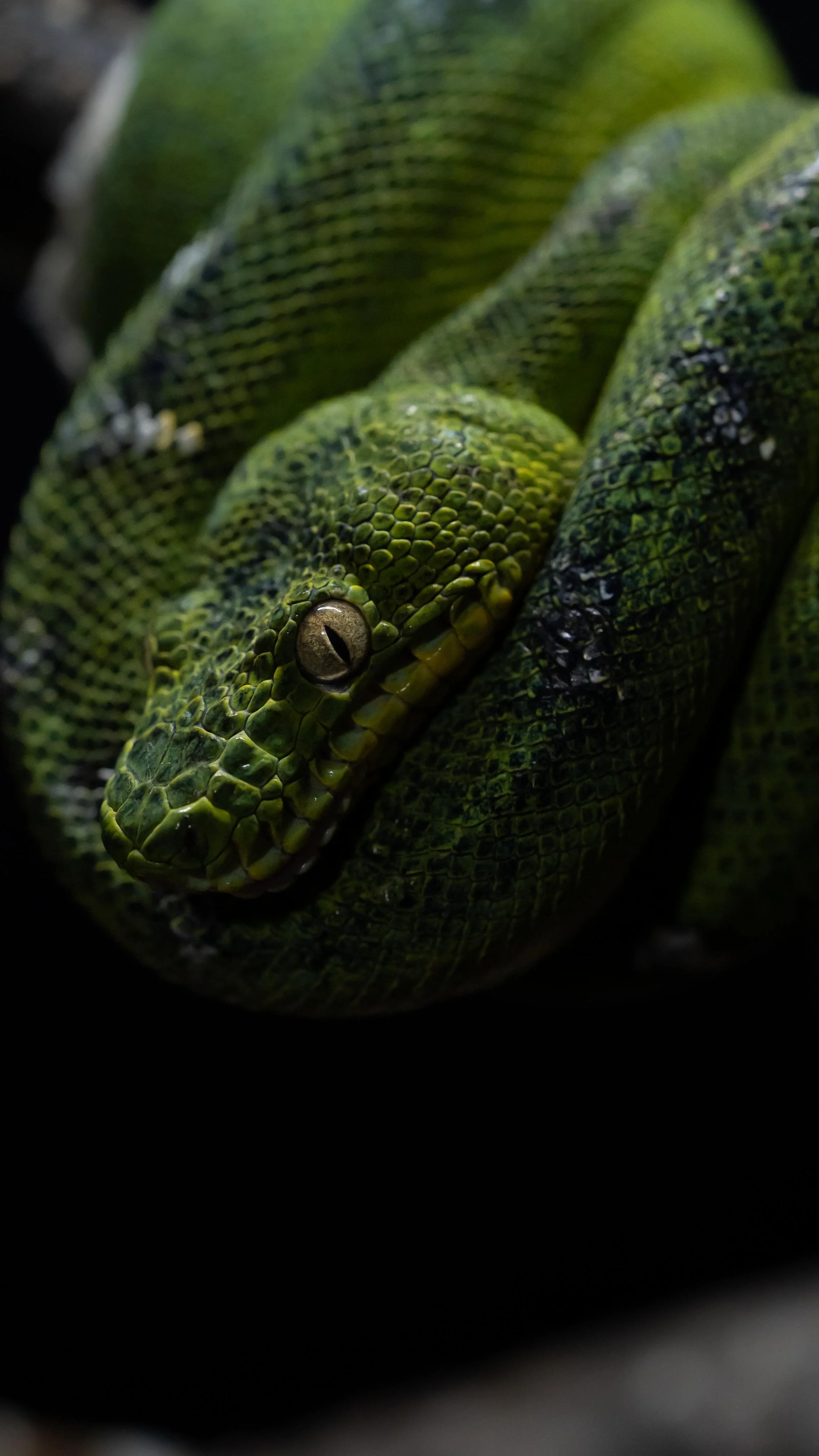
The Northern Emerald Tree Boa (Corallus caninus) is a highly arboreal boa restricted to the Guiana Shield of northeastern South America. It is one of two species in the emerald complex, alongside the Amazon Basin Emerald Tree Boa (Corallus batesii).
Both animals were treated as a single species for more than two centuries. In 2009, Henderson, Passos and Feitosa examined 192 specimens from across the range and revised the taxonomy using meristic, morphometric and color pattern data. Based primarily on lateral blotch counts and the number of scales across the snout, they separated the southern and western populations from C. caninus and resurrected the older name Corallus batesii for them. That revision confined C. caninus to the Guiana Shield, north of the Rio Amazonas and east of the Rio Negro.
The species also attracts significant scientific and educational interest. Researchers study it for its specialized arboreal adaptations, including biomechanics, dentition, thermoregulation, and ontogenetic color change. Its striking appearance and ecological role make it one of the most visually and biologically distinctive snake species in the Neotropics, contributing to both herpetological research and public education.
Distribution
Corallus caninus occurs in:
Guyana
Suriname
French Guiana
Venezuela
in the eastern and southern states of Bolívar and Amazonas
Brazil
north of the Rio Amazonas and north and east of the Rio Negro, in Amapá, Pará, Roraima and Amazonas
Elevation runs from sea level to roughly 200 m. Many care sheets cite an upper elevation limit of about 1,000 m for emeralds. That number traces to a juvenile collected at roughly that elevation at Pozuzo, Pasco, Peru, which Henderson identified as probably the altitudinal extreme for the species. Peru is typically batesii range.
The Rio Amazonas and Rio Negro function as a potential dividing line between caninus and batesii. Large Amazonian rivers act as dispersal barriers for many arboreal vertebrates, and the emerald complex appears to follow that pattern.
Physical Characteristics
Adults typically reach 5 to 6 ft (1.5 to 1.8 m), with large females occasionally exceeding 6.5 ft.
Size
Hobby consensus holds that northerns are the smaller of the two emerald species and that Basin animals routinely exceed them in both length and mass.
Sexual dimorphism is clear with females being heavier bodied and more massive. Males are more slender with proportionally longer tails and larger pelvic spurs.
Diagnostic characters
Three characters separate Guiana Shield animals from everything else in the emerald complex. All three are more reliable than dorsal pattern, which is the thing most people will sort Emeralds by.
Lateral blotches
Guiana Shield animals show the lowest counts anywhere in the range, averaging 1.5 across 32 specimens Henderson examined. For comparison, eastern Brazilian animals south of the Amazon average 16.4, and animals from Ecuador and Peru average 23.4, the highest in the complex. Some northern individuals do carry lateral markings, so this is a population average rather than a per animal rule, but the gap between 1.5 and 16 is wide enough to be diagnostic in practice.
Scales across the muzzle
Guiana Shield animals average 3.4 scales across the top of the snout. Eastern Brazil south of the Amazon averages 6.7. Ecuador and Peru average 8.1. Low counts mean northern.
Mental groove tissue
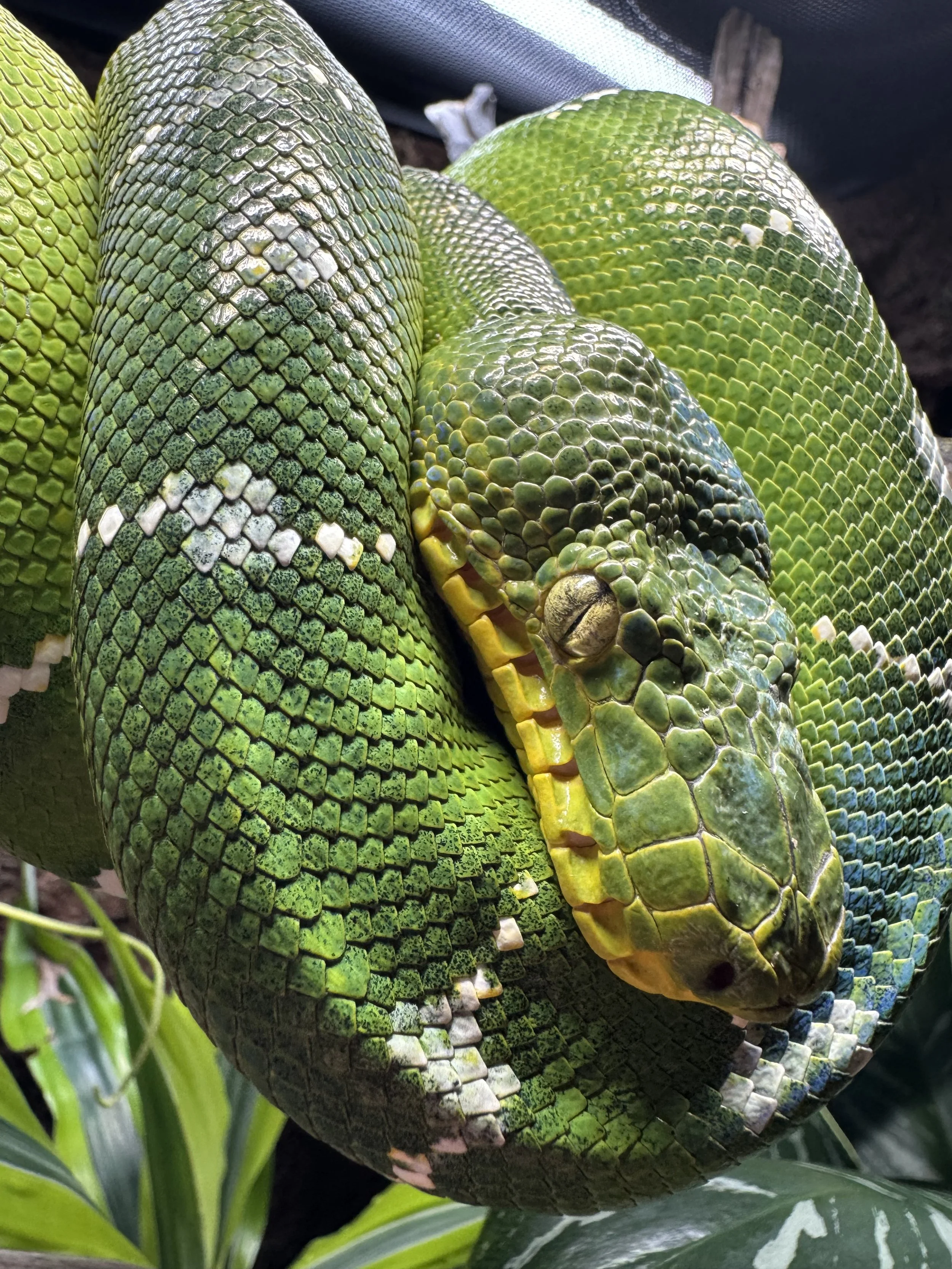
Guiana Shield animals typically show pale tissue in the mental groove, the crease running along the underside of the lower jaw. Animals from eastern Brazil south of the Amazon show black interstitial tissue there. This character undergoes an ontogenetic shift of its own, running yellowish in juveniles and darkening with age, so it reads most clearly in adults.
Coloration
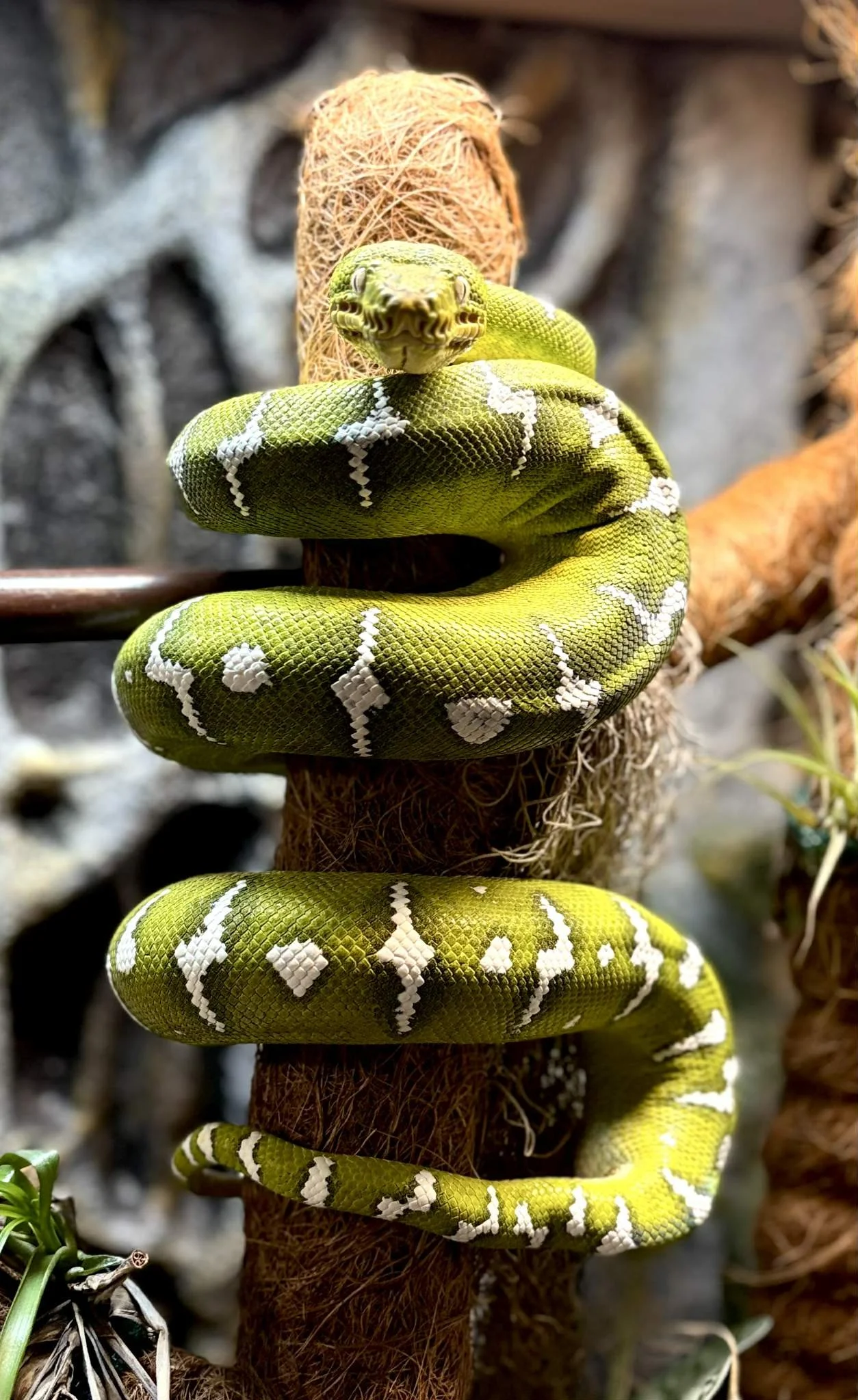
Adults display an emerald green base with white dorsal markings. Unlike Basin animals, which typically carry a continuous or near continuous white dorsal line, northern markings are variable and usually broken. Hobby descriptions call these "lightning bolts." The ventral surface ranges from cream to pale yellow. Yellow highlighting along the edges of the dorsal markings is common in some populations. Some Guiana Shield animals lack the middorsal white markings entirely while remaining otherwise typical, and a photographed animal from Bolívar, Venezuela shows neither middorsal stripe nor lateral blotches.
Ontogenetic color change
Neonates are born red, orange, reddish brown, or occasionally green, and transition to adult green over roughly 9 to 18 months. Yellow neonates, as seen in green tree pythons, do not occur in emeralds. Green neonates are uncommon but documented; Tony Nicoli recorded one green animal in a litter of ten.
Dentition
Emeralds possess exceptionally long, recurved teeth on the front of the maxillae and mandibles, proportionally among the longest of any non venomous snake. The popular explanation is that they evolved for seizing birds through feathers. Henderson offers a different and better supported reading: the teeth function like meat hooks to keep prey from falling irretrievably to the forest floor. For a predator striking downward from a branch, losing a subdued animal to gravity is the main failure mode, and that pressure applies regardless of whether the prey is a bird or a rodent. The bird explanation is a longstanding assumption rather than a finding, and the diet data does not support it.
Habitat & Environment
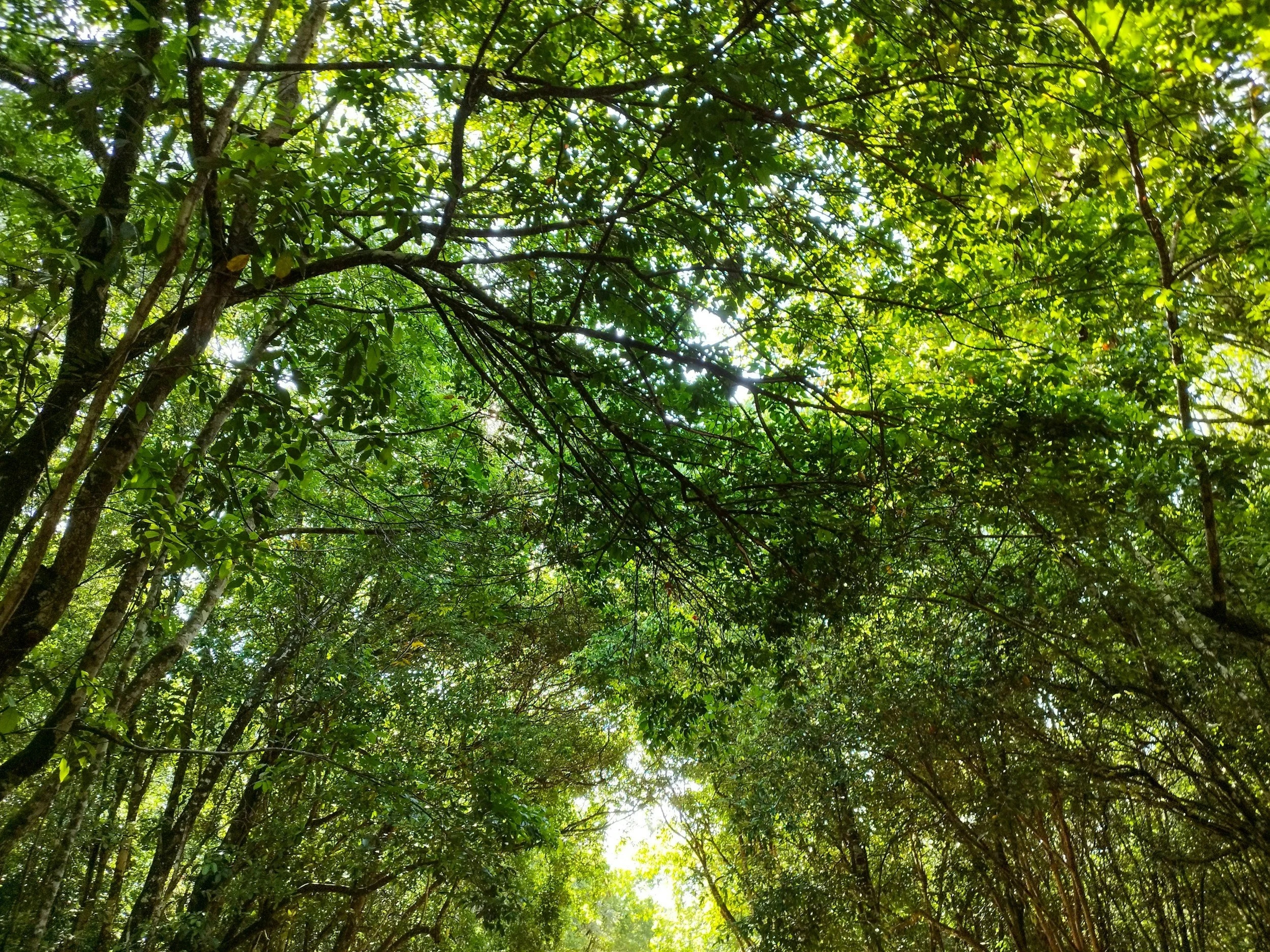
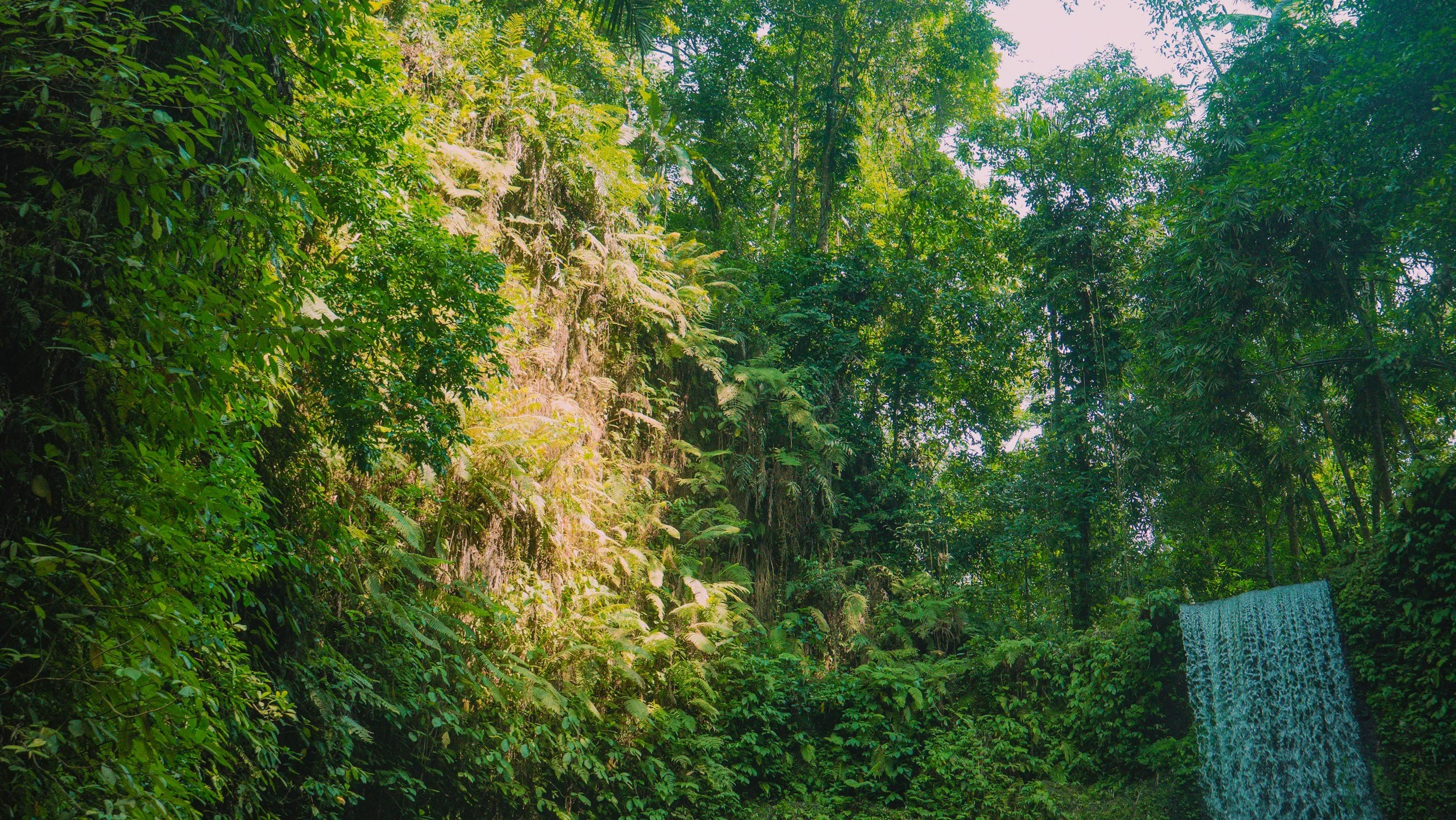
Lowland tropical rainforest, primarily primary forest, though the species is also recorded in secondary growth and swamp forest. Northerns spend nearly all of their lives in the canopy and sub canopy, frequently along branches overhanging streams and rivers.
Typical wild parameters
Humidity:
Daytime: 75 – 90%
Nighttime: 80 – 100%
Temperature:
Daytime: 78 – 88 °F (25.6 – 31.1 °C)
Nighttime: 72 – 80 °F (22.2 – 26.7 °C)
Rainfall: heavy and consistent year round, generally in excess of 1,500 mm annually.
Elevation: sea level to roughly 200 m typical.
These conditions provide both the moisture and temperature stability essential for thermoregulation, camouflage, and hunting in the rainforest canopy. The dense foliage and proximity to water also support the abundance small mammals that make up the snake's diet.
Behavior, Diet, & Lifespan
The Northern Emerald Tree Boa exhibits highly specialized nocturnal to crepuscular behavior, spending daylight hours resting hidden in the mid- to upper-canopy branches. By night, it becomes an active hunter, relying on stealth, ambush strategies, and precise strikes. Wild individuals are typically defensive and can react aggressively if disturbed, but captive-bred specimens often adapt to human presence, showing increased tolerance with minimal, consistent handling. The species' characteristic posture—coiled over a branch in a "saddle" position—provides both stability and an optimal strike angle when hunting.
Diet & Feeding: As ambush predators, Northern Emerald Tree Boas depend on exceptional camouflage and the element of surprise. Their heat-sensing pits allow detection of warm-blooded prey even in dense foliage or low light. The diet consists mainly of small arboreal mammals, such as rodents and bats, and birds, which they strike with precision from above. Juveniles may occasionally feed on small reptiles. Feeding behavior is highly selective and opportunistic, with individuals demonstrating patience and calculated timing during hunting. Captive studies have shown that the snakes can remember hunting locations and may strike multiple times in succession if prey attempts to escape.
Growth & Lifespan: Northern Emerald Tree Boas grow slowly, reaching sexual maturity around 3–4 years for males and 4–6 years for females. Wild individuals typically live 15–20 years, while well-maintained captive specimens often surpass 25 years. The species' slow growth and longevity are closely linked to its specialized arboreal lifestyle, low predation risk in the canopy, and energy-efficient hunting strategies.
Activity
Nocturnal to crepuscular. Daylight hours are spent coiled in the characteristic saddle position, body looped over a branch with the head resting at the center of the coil. This posture provides both stability and safety.
Temperament.
Northerns carry a reputation for being defensive, and wild caught animals frequently can be, although there are many factors that add up to this defensiveness and is not a characteristics “baked” into Emeralds. Captive bred animals are generally more tolerant. Several long term keepers note that emeralds are calmest during the day and become far more reactive after dark, once they shift into active mode.
Diet.
Emeralds are ambush predators that rely on camouflage and heat sensing labial pits to detect endothermic prey. The diet is dominated by small mammals, principally rodents such as rice rats (Oecomys sp.), along with opossums and lizards.
Bird predation deserves a direct correction, because it is one of the most widely repeated claims about this species. Henderson states plainly that despite frequent references to a bird diet in both the popular and the technical literature, stomach content analysis has failed to support it. He goes further, reproducing an old print of an emerald taking a domestic chicken and captioning it to note that there is no evidence of emeralds preying on birds by day or night. What field observation does support is an ambush predator that may perch surprisingly close to ground level with its head angled downward, waiting for a rodent to pass below.
Prey density
Henderson contrasts emeralds with Corallus grenadensis on Grenada, where he calculated densities above 50 treeboas per hectare because the local prey base is abundant anoles. Emeralds prey almost exclusively on small mammals occurring at far lower densities, which is part of why the species is nowhere common across its range. A density estimate of one emerald per 2.7 km² exists from San Martín, Peru, though the investigator who produced it doubted its reliability.
Growth and lifespan
Slow growing. Males reach sexual maturity around 3 to 4 years, females around 4 to 6. Wild lifespan is estimated at 15 to 20 years; well maintained captive animals commonly exceed 25. Nicoli documented a wild caught Suriname female still producing litters into her mid twenties.
Reproduction
Viviparous, with gestation around 6 to 7 months. Litter sizes commonly run 5 to 15. Larger litters are recorded: Nicoli reported batches of 12, 15, 18 and 23 from a single Suriname female over twelve years, with 23 being the largest emerald litter he had encountered.
Predators
The only confirmed natural predator on record is the Guianan crested eagle (Morphnus guianensis).
Locality Forms and Hobby Terminology
This is where the emerald hobby gets murky. Below, documented localities are separated from trade names.
Documented localities
These correspond to actual country of export and, in better cases, to collection data.
For scale: between 1990 and 1996, 6,830 emeralds were exported from Guyana and Suriname. Henderson notes the species is nowhere common across its range and occurs mostly in primary rainforest, which is disappearing rapidly.
Guyana. Generally described as showing rounder, more open bolt shapes than Suriname animals, often with yellow bordering the white markings, and a clean bright white that holds its crispness. Guyana became a distinct working category in the hobby around the early 2000s as importers began documenting country of collection rather than shipping everything as generic "Suriname."
Suriname. The longest established northern locality in captivity. Markings are typically broken, patchy, and lacking the connected dorsal line of Basin animals. Keepers have long divided Suriname animals into light and dark phases, and Nicoli reported that both phases appeared to breed true across generations in his collection. He also observed that bloodlines from the earliest Suriname imports differed noticeably in color and temperament from animals imported later, with the early line being unusually calm and highly prolific.
French Guiana, Venezuela, and northern Brazil. All within the confirmed range of C. caninus, but essentially absent from the captive population as documented localities. Almost nothing in the trade traces to these regions.
Trade names and phases
These describe appearance, not origin. Some may eventually prove to have a geographic basis, but none currently does.
Light phase and dark phase
Describes the amount and intensity of dark green to black pigment surrounding the white markings. Reported to breed true within Suriname lines.
Black morph
Heavily melanistic animals. Nicoli worked with a pair he believed came from a wild caught female of unknown origin, probably somewhere in Suriname or Guyana, with the male roughly 80% black and showing a purple iridescence in sunlight comparable to a Boelen's python. Notably, both animals carried lateral markings, which complicates any clean northern assignment.
Patternless
Solid green animals with little to no white, sometimes retaining faint dark patterning.
Anaconda phase
A category used by some breeders that has very faint dark markings combined with the patternless phenotype.
"New locality”
The phenotype of the white markings on the head is documented, photographed, and demonstrably heritable. Its geographic origin is unknown and has never been established.
Miss Willie Line
The only line bred Emerald within the Hobby. This Emerald Tree Boa gene presents itself with large white markings on the offspring and the adults. European Breeders have been working on truly “developing” this trait for the last 10+ years.
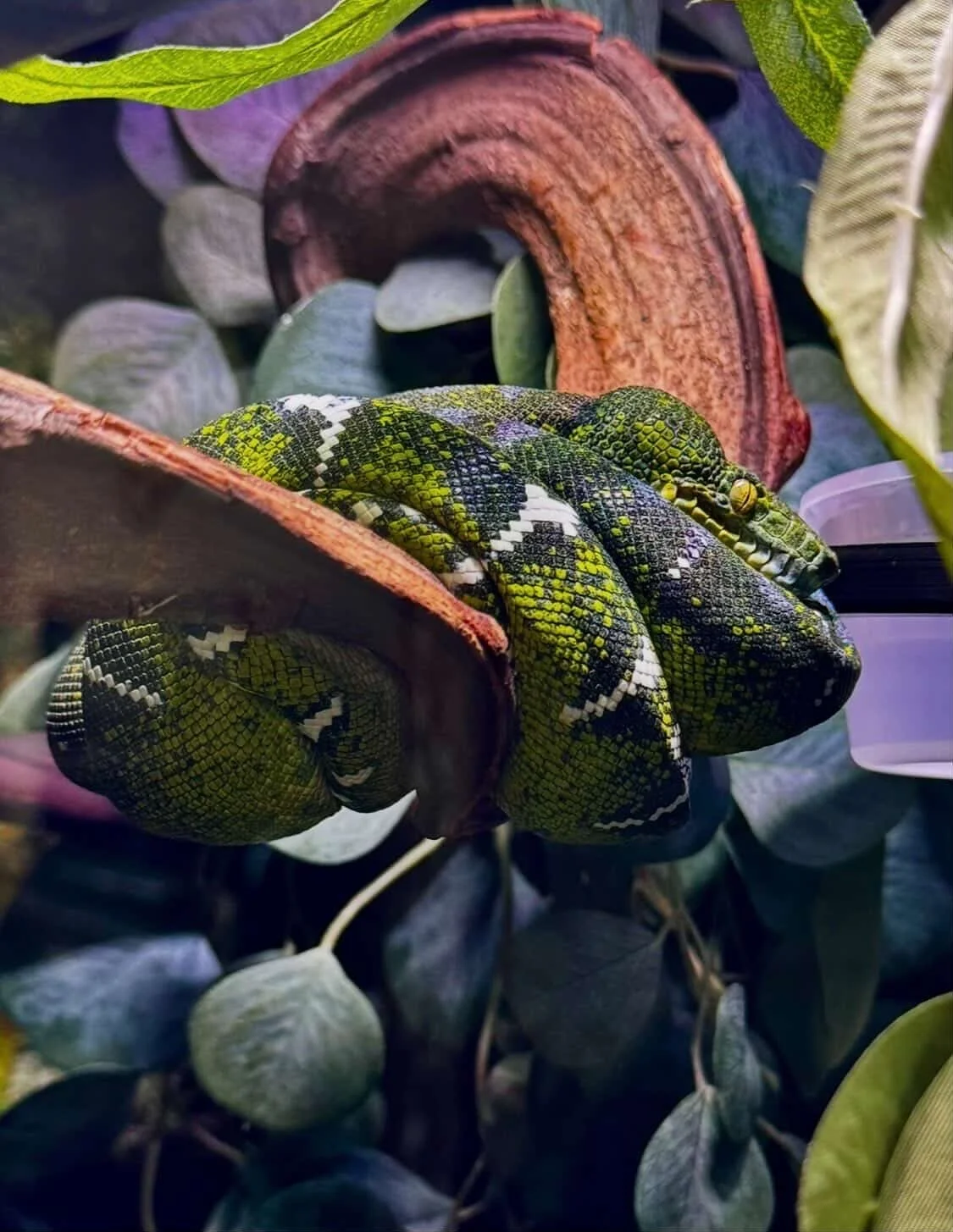
Northern Emerald Tree Boa Variations
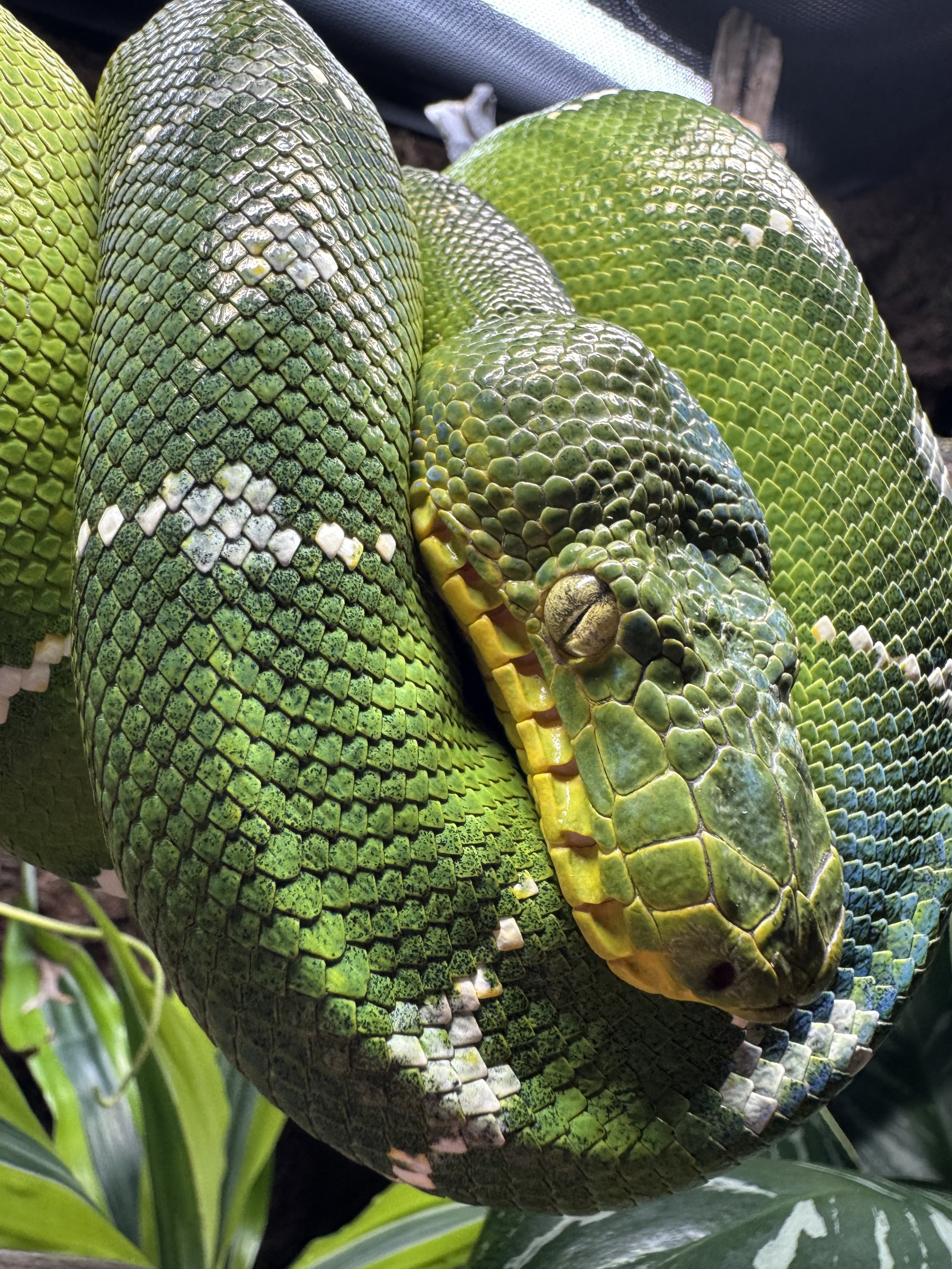
Normal Emerald Tree Boa - Owner: Zion McAndrews
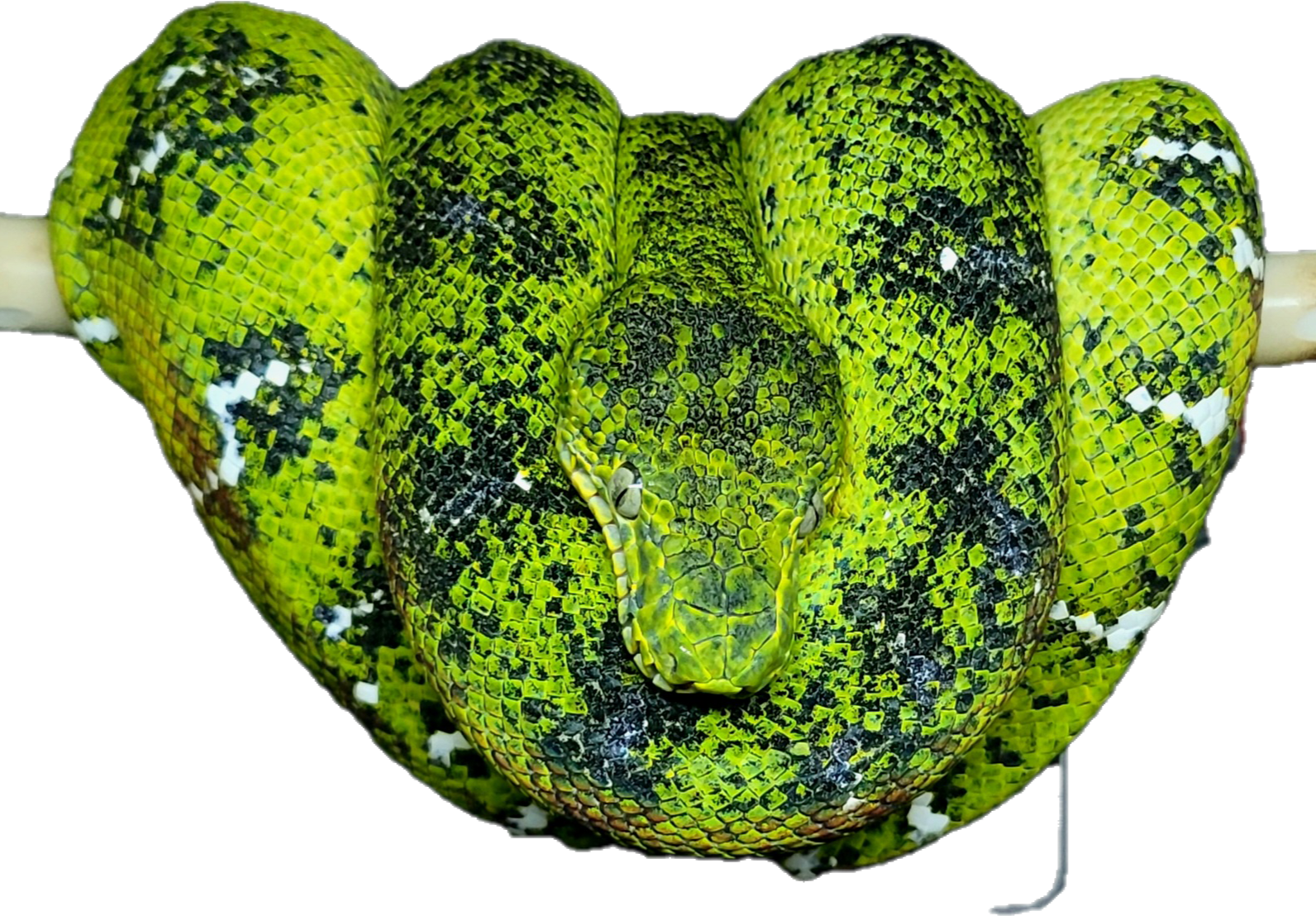
Granite Northern Emerald Tree Boa - Owner: Keith Flax
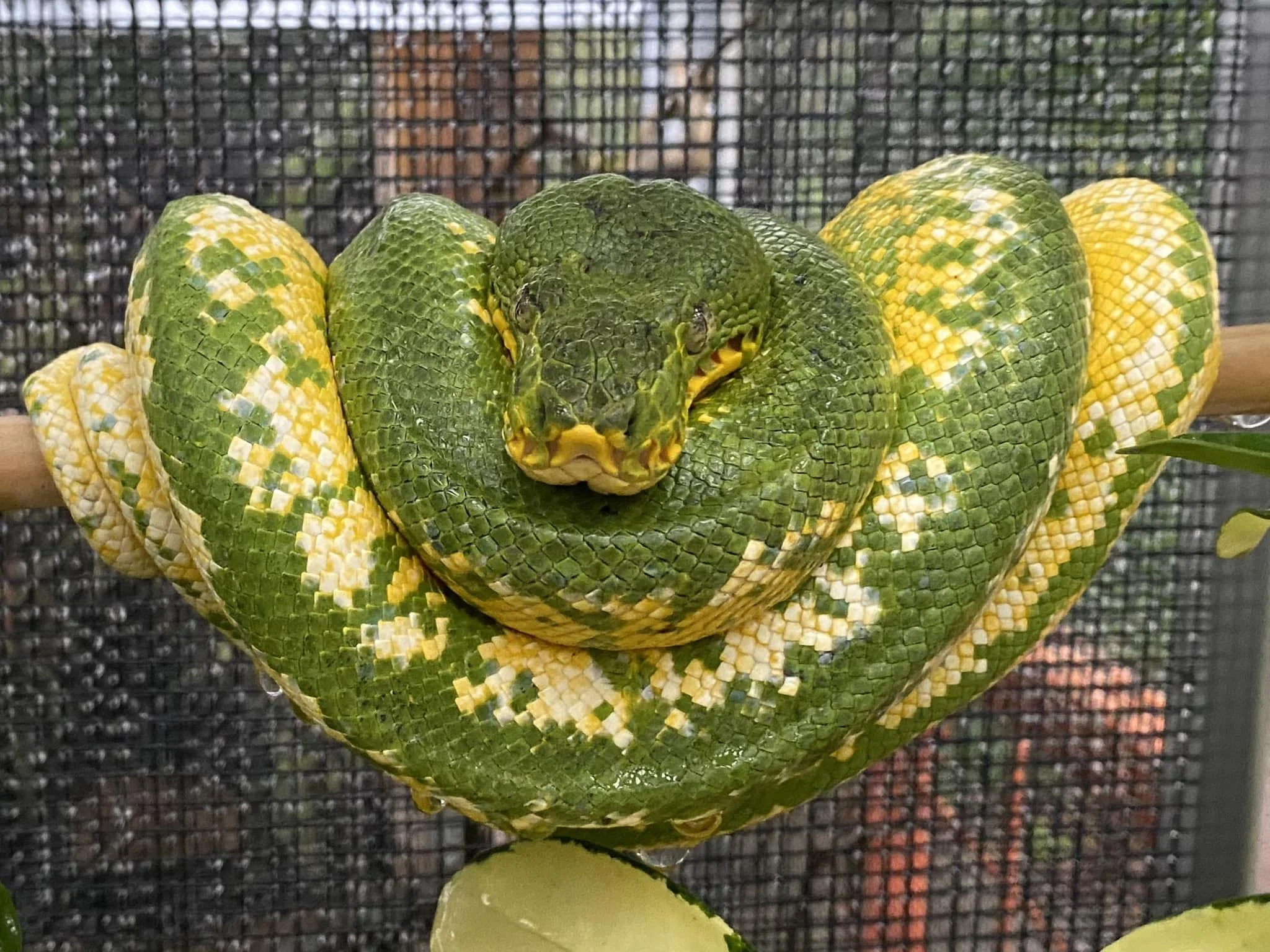
High Yellow Northern Emerald Tree Boa - Owner: Ron St. Pierre
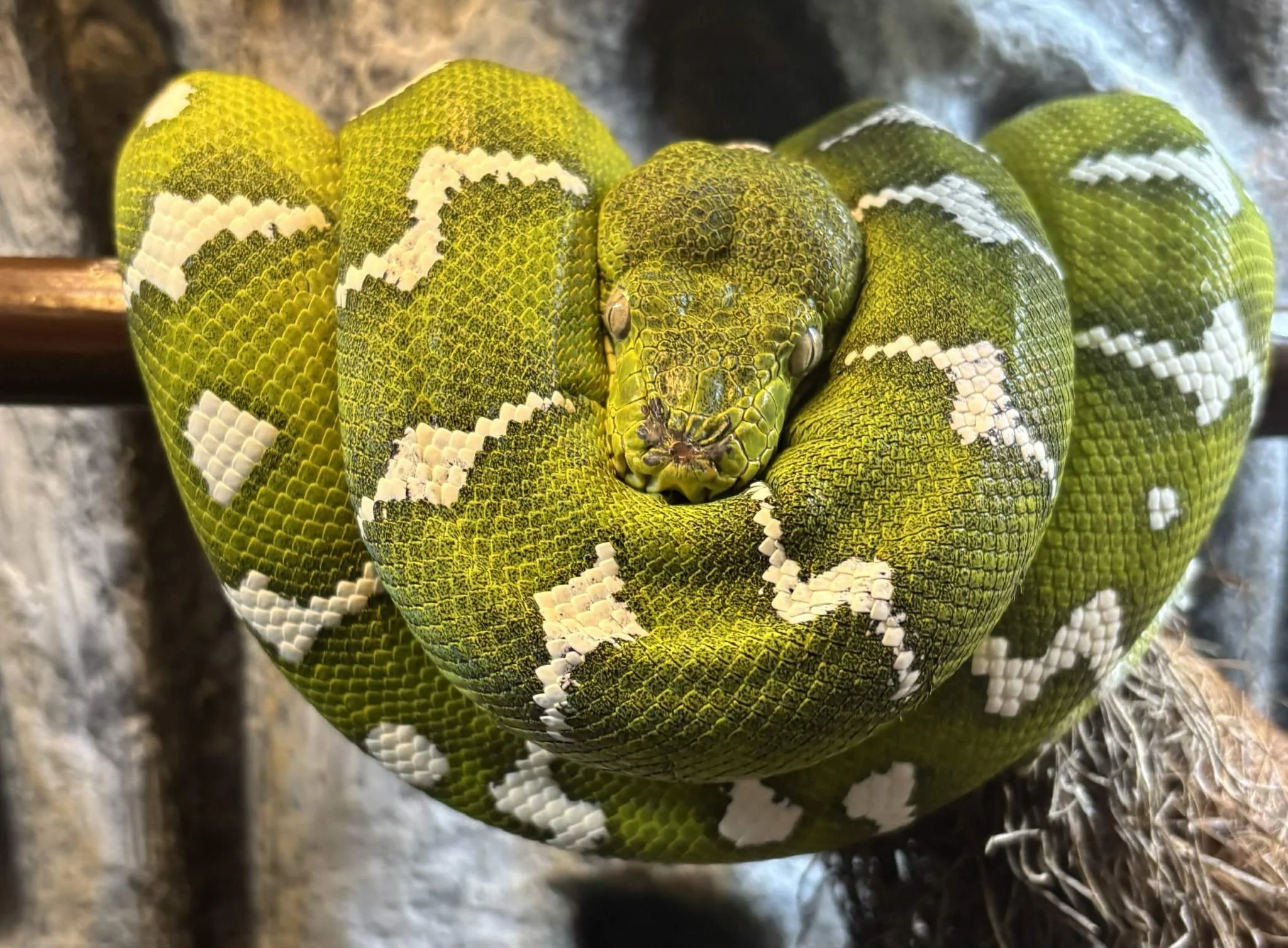
Miss Willie Line Northern Emerald Tree Boa - Owner: Legacy Rept
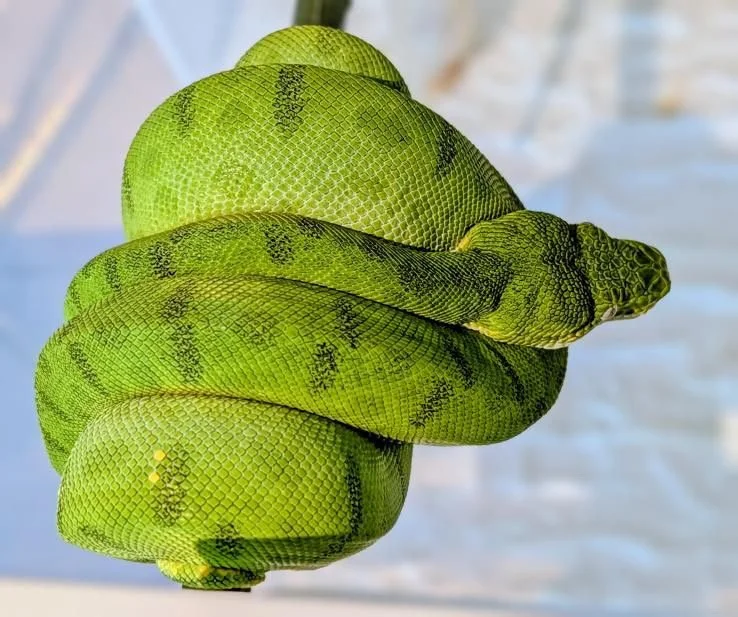
Anaconda Phase Northern Emerald Tree Boa - Owner: Noc Arboreals
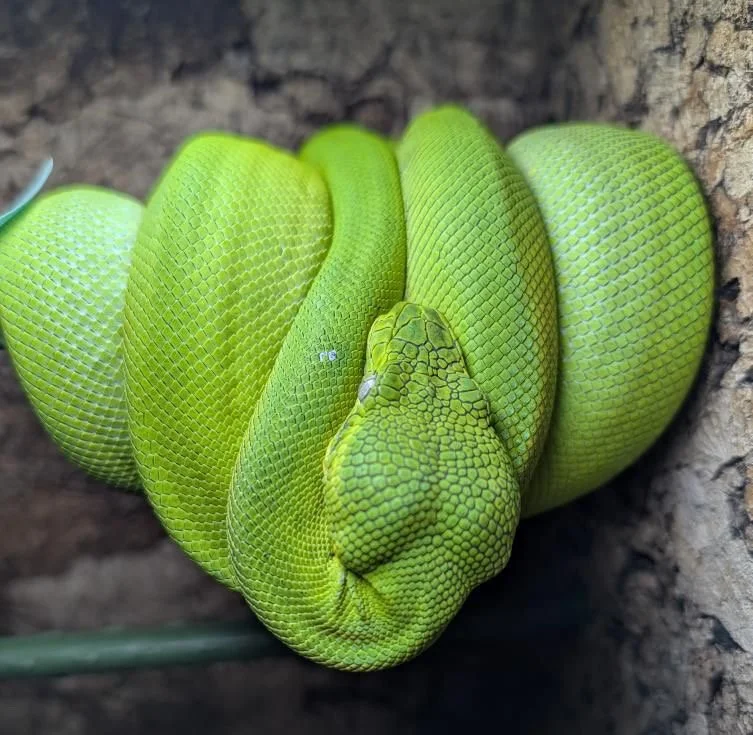
Patternless Northern Emerald Tree Boa - Owner: Noc Arboreals